ASTRONOMY 3150
INTRODUCTORY ASTROPHYSICS
EXERCISE ASSIGNMENTS
(updated assignments are linked)
THE CELESTIAL SPHERE
1. Object Visibility: Write a spreadsheet (Excel) program to determine
the altitude and azmuth of a celestial object as seen from the new observatory
site. The program should use the object's RA and declination, the
time and date of observation, and the location of the new observatory site:
(34.521 N, 84.055 W) The equations needed to write this program may
be found in the Observer's Handbook. Among other things, you will
need to determine the local mean sidereal time (LMST) and then the hour
angle for the time and location of the observation in order to complete
the program. Check your work by using the celestial coordinates and
time of observation of the object you plan to observe for project 1 and
compare the spreedsheet program's alt. & azm. to the alt. & azm.
determined from The Sky.
ORBITS
2. From the Earth to Mars - Spaaaaaaaaaaaaace Cadets!: Assume
circular orbits for Earth and Mars. Determine the semimajor axis
length and eccentricity of the Hohmann transfer orbit between them.
(Optional for extra credit: Use a plotting program of your choice to plot Earth's, Mars' and the Hohmann
orbit between them to scale.) Using Earth and Mars' circular orbit speeds, the escape velocity from Earth's
surface, the vis-viva equation for the Hohmann orbit, and conservation of energy
considerations in the vicinity of Mars to determine all the "delta-vee's" for a trip from Earth
to Mars. Here is a list of the "delta-vee's":
Dv(1) = escape speed from Earth's surface,
spacecraft is now in orbit around the Sun with the same speed as the Earth's
circular orbital speed
Dv(2) = change in speed from Earth's cir. orb.
speed to perihelion speed of Hohmann orbit, spacecraft begins long
"climb" to Mars' orbit distance
Dv(3) = change in speed necessary to soft-land
on Mars; assume your trajectory is such that the spacecraft arrives 100 Mars'
radii directly ahead of the surface of Mars at the instant of Hohmann orbit aphelion; use the following
procedure: determine the difference between the Hohmann
orbit aphelion speed and Mars' circular orbit speed (this would be the closing
speed between the spacecraft and Mars at the point when the spacecraft is 100
Mars' radii above the surface); use energy considerations to determine the speed
at which the spacecraft would hit the surface, ignoring atmospheric friction;
this "impact speed" should be the "delta vee"
necessary to slow the spacecraft down for a soft landing on the surface
BINARY STARS (EXO-PLANETS)
3. Using the measured orbital period and inclination
(from light curve) of the extra-solar planet HD209458b; and the measured
projection of the orbital velocity (from velocity curve) of the parent star
HD209458a, plus the stellar mass as determined by its spectra type:
determine the mass of HD209458b.
BLACK HOLE MASS (STARE EXAMPLE)
4. Not updated yet.....
BLACKBODY SPECTRA
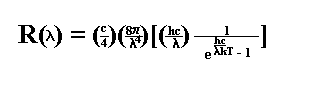
5. Characteristics of black body radiation: Derive from the
Planck formula; (a) Wien's Law [ lmax =
0.002898 m.K/T ] and (b) Stefan-Boltzmann Law [
I = sT4 ] where I is the total power per
unit area radiated by the black body.
STELLAR SPECTRA
6. Relative Line Strengths With Temperature: Apply the Boltzmann
and Saha equations as found in your notes to determine the relative line
strengths of the Hydrogen Balmer line as a function of absolute temperature.
Use a spreadsheet (or Maple if you like) to create a plot of this function and compare it to figures
8-13 and 13-6 in your textbook. Your instructor will give you a sheet
of constants that you will need.
7. TBA