DEPARTMENT OF PHYSICS
ASTRONOMY 1010/1020
ASTRONOMY OF THE SOLAR SYSTEM
CLASS PARTICIPATION
GRADE
METHOD OF EVALUATION:
-
Class participation will be partly determined
by attendance which will be taken regularly.
-
Everyone begins with 100 points for
the in-class participation grade. Five (5) points will be deducted
for each 50-minute class period absence. Two night a week evening
classes which meet 50 minutes one class period & 100 minutes the other
will have 5 and 6 points deducted respectively. Regular two day a
week classes will have 6 points deducted for each absence. One night
a week evening classes which meet 150 minutes per class period will have
7 points deducted for each absence. Short summer session classes
which meet 100 minutes, MTWR will have 5 points deducted for each absence.
For all the above class formats, only three (3) points will be deducted
for absences due to university-sponsored activities that are approved by
the V. P. for Academic Affairs or the V. P. Student Affairs.
-
Participation grade points may be deducted
or added at the discretion of the instructor during class periods.
For example, if a group fails to research a question and cannot report
an answer when called upon during the class participation time, points
may be deducted (especially if a group fails to report multiple times).
Individuals sleeping in class may have points deducted as well. If
a group or individual responds to a question in a manner in which the instructor
deems to be superior, points may be added to the participation grade.
-
As stated in the syllabus, extra or
make-up points for the participation grade are possible by observatory
attendance and participation in designated extro-class labs. (Even
if you are not taking the lab.) Each certified observatory attendance
will count one (1) point on your participation grade and the designated
extro-class labs usually count three (3) points each.
-
If a student misses the equivalent of
seven 50 minute classes (~14% of scheduled classes), it is the prerogative
of the instructor to drop the student from the class roll with a W or WF,
or to continue the student in class. Seven 50 minute absences results
in a participation grade of 65. If the class participation grade
is below the exam average at the end of the term, then only the exam grade
average will be used to designate the letter grade. This means that
the participation grade can only help your final grade and not lower
it. Note however that perfect attendance results in a class participation
grade of 100 which counts 25% of the class grade, easily enough to raise
most averages one letter grade. For example, if a student has an
exam grade of 75 and a participation grade of 100 their final class grade
would be 81, a "B" rather than the "C" (75) if only the exam average is
used. It is very advantageous for the student to participate fully
by class and observatory attendance as full participation almost
always results in a higher letter grade.
PARTICIPATION GRADE ATTENDANCE POLICY:
-
Class participation is determined in
part by attendance. If you are absent from class then you are NOT
participating.
THEREFORE, ALL
ABSENCES WILL BE COUNTED, NO MATTER WHAT THE REASON! This
includes but is not limited to absences due to illness, death in the family,
family emergency, university sponsored events, athletic events, military
events, and transportation problems. Absences during a scheduled
exam are counted even if you are allowed to make-up the exam at another
time. See Method of Evaluation above for details related to class
format and "excused" absences.
-
However, it is possible to make-up points
lost due to absences by superior in-class participation, observatory attendance
and extro-class lab participation. (Even if you are not taking the
lab course.) See Method of Evaluation above for details.
-
Five observatory attendances (which
are counted as extra points on the participation grade) are equivalent
to making up one 50-minute class period absence. Participation in
designated extro-class labs may also be used to make-up class absences
or for extra points on the participation grade. Designated extro-class
labs usually count three points on the participation grade.
Please contact your professor if you have any questions about
the class participation grade.
SMALL GROUP FORMAT
SIZE AND COMPOSITION:
-
Maximum 3 students per group.
-
Group members will be chosen in alphabetical
order from class roll.
STRUCTURE:
-
Moderator: Moderates group discussion
of researched notes, questions and issues.
-
Recorder: Records notes, questions
and issues generated by the group.
-
Spokesperson: Liaison with instructor
during small group discussions and presents researched notes, questions
and issues during report periods.
OPERATION OF GROUPS:
-
The instructor will post discussion/essay
questions covering topics from the online outline at each class period.
(Probably three questions per 50 minute class period.) By using the
online outline, students should be able to determine upcoming topics.
They should read and review the material related to those topics in the
textbook before class. All groups will research the questions using
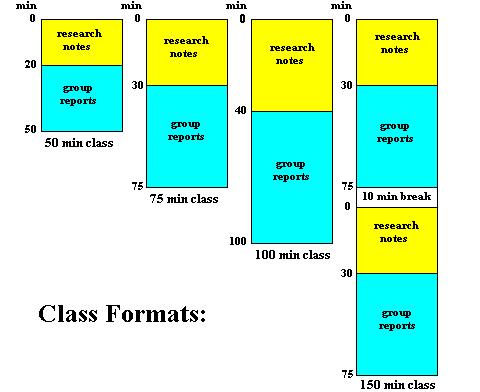
the outline and the textbook for approximately 40% of the class time.
The rest of the class time will be reserved for groups to report their
researched notes on the assigned questions. See the diagram below
for specific class formats.
-
The instructor will choose groups at
random to report on the questions. After a group reports on a question,
there may be discussion/questions from other groups and supplemental lecture
from the instructor. Other group or class activities (class demonstrations,
exercises, etc.) may also be completed during this portion of the class.
-
Participation grades are derived from
class participation, class attendance, and extro-class participation.
See above for details.